
Practical security
Your coding agent can repeat insecure patterns: fix the template
By Qlinnt · Updated
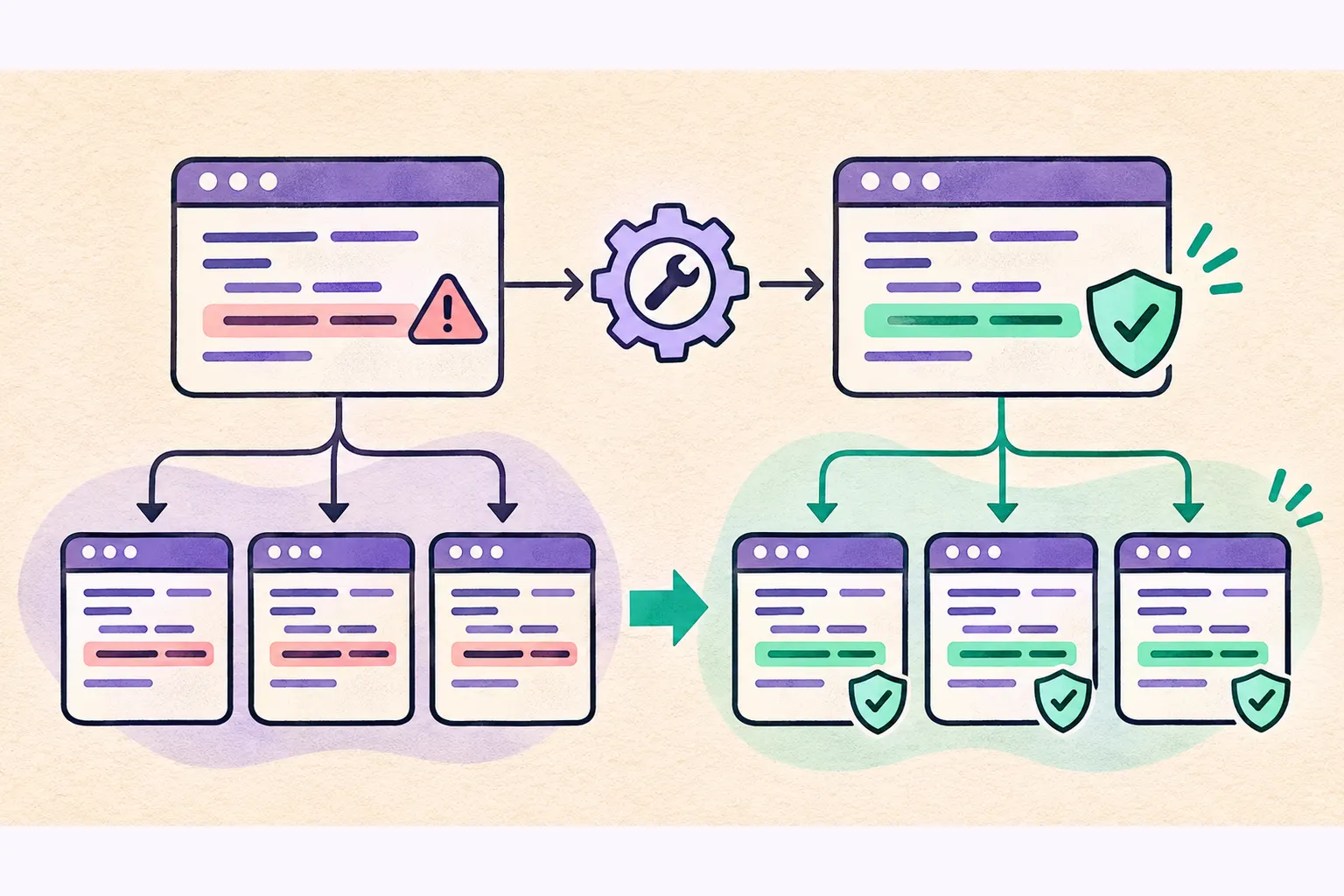
When a security problem repeats, correct the shared pattern and give the agent a safe example plus a failing test. A warning in a prompt is useful context, but it is not a substitute for fixing the code, configuration and tests the agent copies.
Understand the problem before changing your site
Developers and coding agents both use nearby code as an example. A permissive authorization helper, unsafe HTML insertion or missing upload validation can therefore become a template for new features. Correcting one screen leaves other callers and future changes exposed to the same mistake.
It is not possible to infer from a deployed frontend that AI caused a vulnerability. Controlled research about coding behavior also does not predict every project's long-term risk. The practical response is to make the safe implementation easier to reuse than the unsafe one.
What to review and how to reduce risk
- Trace the finding to its source: shared component, middleware, policy, upload handler or generated template.
- Search for equivalent patterns across routes and packages, including older copies that no longer import the main helper.
- Write a regression test with synthetic data that demonstrates the undesired access or rendering behavior.
- Replace the shared pattern and show the coding agent the tested safe implementation. Specify behavior and constraints instead of asking only to make it secure.
- Review the diff and run positive and negative tests. Check that legitimate users and public content still work.
How to verify it with safe tests
For an authorization example, use two test users and separate synthetic records. Assert that each can read their own data and cannot read the other's data through the API. The interface hiding a button does not establish that boundary.
For a frontend pattern, test the reusable renderer with ordinary text and an untrusted markup marker. Keep a regression for every affected entry point. Then scan the deployed public routes to verify the externally observable part of the correction.
What Qlinnt can check and where its scope stops
Qlinnt can identify some repeated public symptoms, but it does not read your repository or prove all copies of a helper were fixed. Its scan scope remains the submitted page and up to four prioritized internal routes, not the entire application.
Treat an agent's explanation as a proposal for review. A passed public check cannot certify backend authorization, dependency integrity or the origin of the code. Combine source-level tests with a repeatable public-surface check.
Is telling an agent to be secure enough?
No. Supply safe patterns, explicit requirements and tests that would fail if the unsafe behavior returns.
Can Qlinnt tell whether AI wrote insecure code?
No. Public symptoms do not establish who or what produced the implementation.
Sources and further reading
Review your website's public surface
Scan a website you own or are authorized to assess. Verify your email to read the free diagnosis. The scan does not replace code tests or a specialist assessment.
Scan my website for free