
Security methodology
AI-assisted CVE discovery vs. what a public URL scan checks
By Qlinnt · Published
AI agents can accelerate deep source-code audits when guided by an engineer, but finding a clue is not the same as proving exploitability—and backend runtime CVEs like JVM Base64 bugs require server patching, not frontend URL scanning.
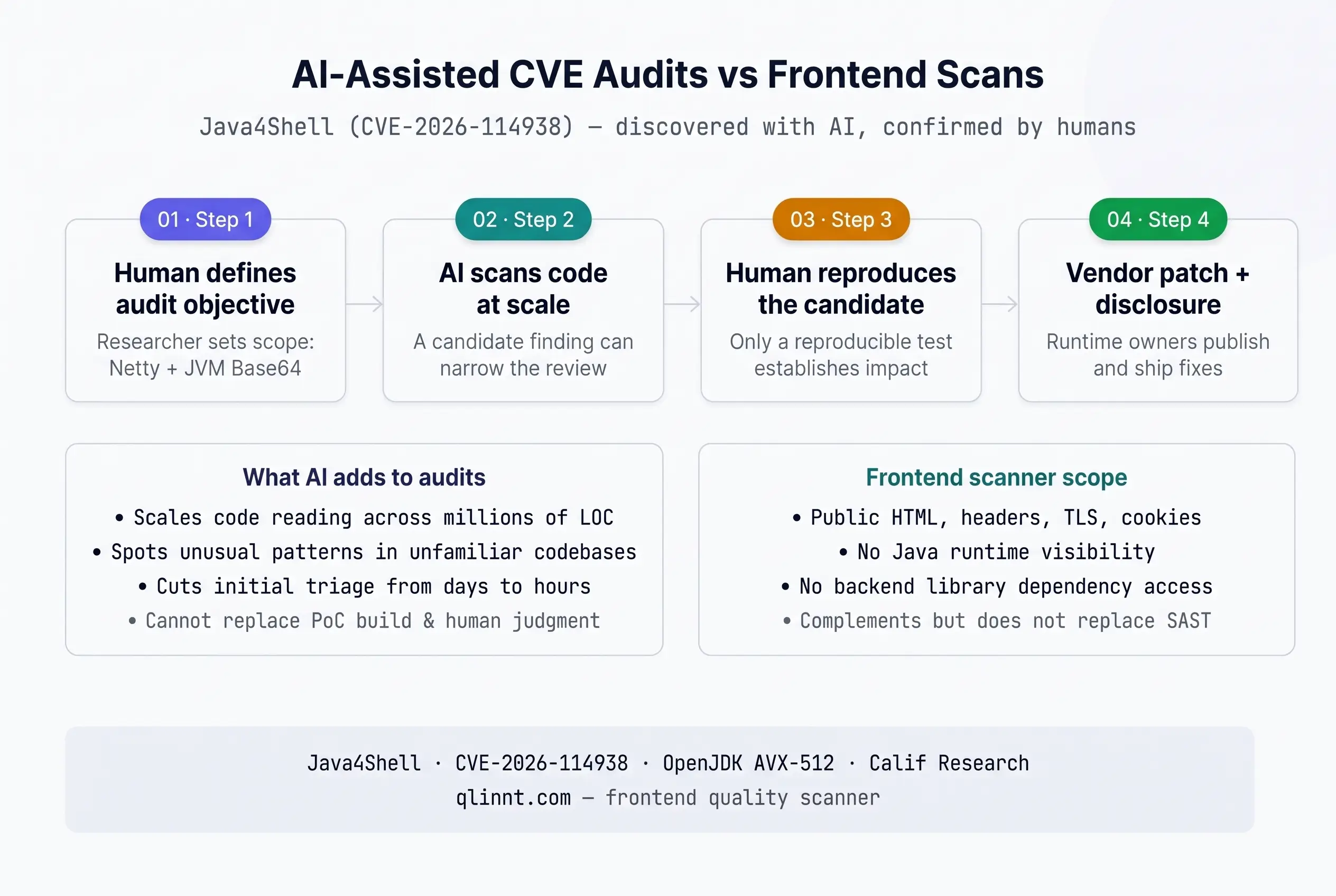
Understand the problem before changing your site
When security researchers disclosed Java4Shell (CVE-2026-114938), an issue in OpenJDK's optimized Base64 decoder affecting specific x86-64 hardware instructions, they highlighted that an AI coding agent helped locate the bug quickly once a human specialist narrowed down the audit target.
At the same time, exploitability depended on runtime version, CPU instruction sets, and server code paths—none of which can be reliably confirmed by inspecting public HTML. Knowing which layer each tool covers prevents blind spots and noisy false alarms.
What to review and how to reduce risk
- Keep server runtimes, JVM/Node dependencies, and container base images patched through automated dependency updates and vendor advisories.
- Use AI assistants to speed up targeted code reviews, but require reproducible test cases and human verification before treating any candidate bug as confirmed.
- Separate infrastructure/runtime scanning from public web surface scanning so each layer reports only what it can genuinely observe.
- Audit your public frontend surface after every deployment for issues visible in the browser: missing security headers, exposed secrets, weak CSP, or DOM injection surfaces.
How to verify it with safe tests
Maintain an inventory of server runtimes and SBOM dependencies in CI to detect vendor-patched CVEs independently of frontend checks.
Run a read-only public scan on your live domain to verify client-side posture without guessing backend internals from HTTP headers.
What Qlinnt can check and where its scope stops
Qlinnt deliberately does not emit speculative backend runtime alerts such as Java4Shell because JVM versions, CPU features, and internal Base64 paths are invisible from public frontend responses.
Use runtime advisories and server scanners for backend CVEs, and use Qlinnt to catch the frontend security, SEO, performance, and configuration issues left on the public web.
Questions before you scan
Why doesn't Qlinnt add a rule for Java4Shell?
Exploiting or confirming it requires knowledge of the exact OpenJDK version, CPU instructions, and backend code path—none of which a read-only frontend scanner can verify reliably.
Do AI agents replace security verification?
No. Agents speed up locating candidates, while reproducible proofs and human judgment establish real impact.
Sources and further reading
Review your website's public surface
Scan a website you own or are authorized to assess. Verify your email to read the free diagnosis. The scan does not replace code tests or a specialist assessment.